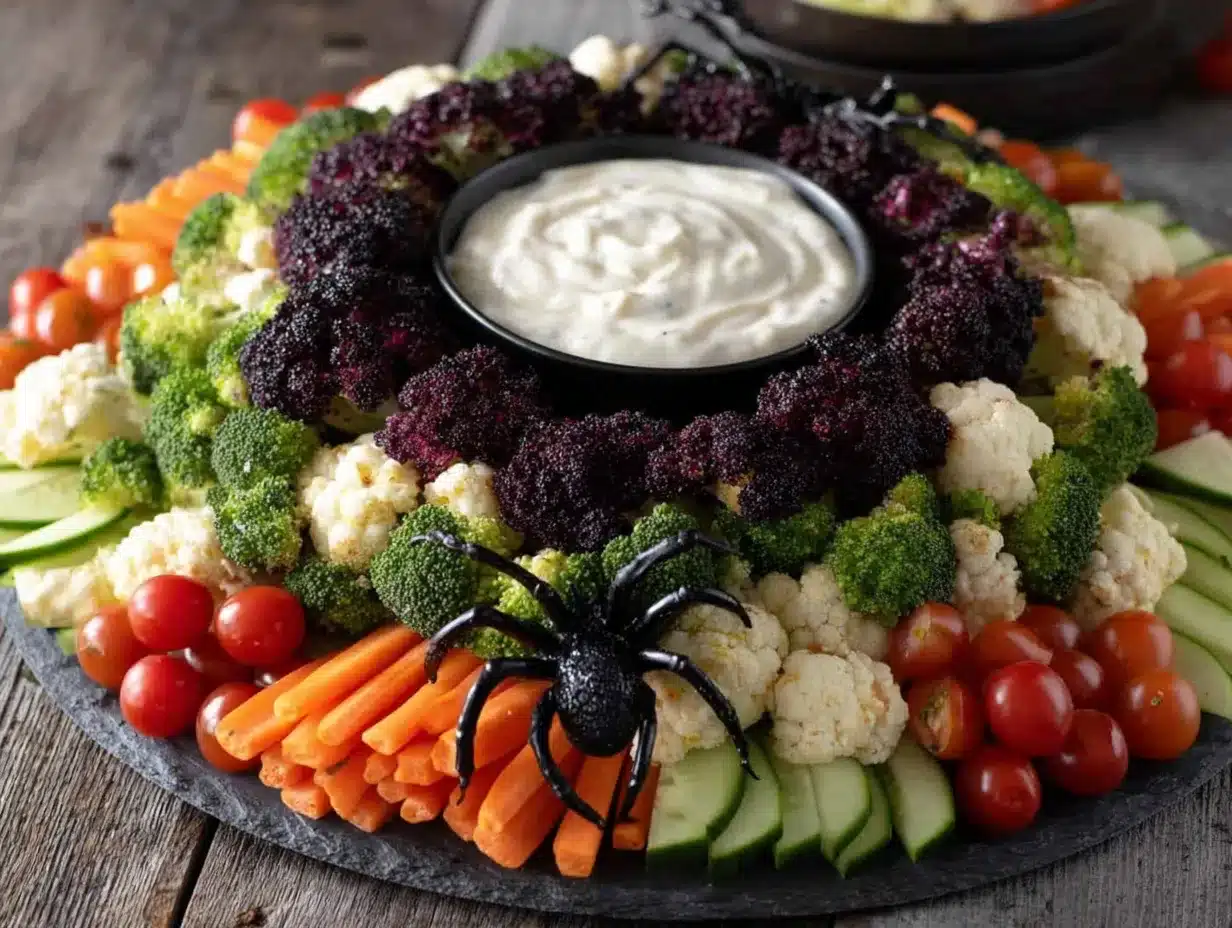
The way the dark, sticky spider web stretches across that platter—thin strands of black sesame paste pulling apart into something that looks both delicate and deliberate—that’s the whole reason I make this tray every single October. The veggies are just the delivery system, honestly. The web is the star.
I didn’t grow up with Halloween parties that involved anything more elaborate than a plastic pumpkin bucket and a pillowcase full of candy. It wasn’t until my early twenties, when a friend asked me to bring “something spooky but not dessert” to her annual costume party, that I panicked and grabbed a bag of baby carrots, some hummus, and a jar of black tahini I’d been experimenting with. I drizzled it in a messy spiral, dragged a toothpick through it, and called it a spider web. People lost their minds. Not because it was fancy—it was the opposite. It was the kind of thing that made you feel like you’d put in effort when you’d really just… drizzled something.
That first attempt was ugly. The web broke apart, the hummus was too thick, and I ended up with black paste all over my fingers. But the idea stuck with me. Over the years, I’ve refined it into a reliable, almost meditative little ritual. The spooky easy Halloween veggie spider web tray has become my signature contribution to every fall gathering, from casual pumpkin carving nights to the big costume party. It’s the one thing that disappears before the candy bowl even gets touched, and honestly? That feels like a small victory every single time.
There’s something quietly satisfying about watching people hover around a tray of vegetables, not because they’re being healthy, but because the presentation tricked them into thinking it’s part of the fun. And it is. The web does the heavy lifting. The veggies just show up.
Why You’ll Love This Recipe
I’ve tested this tray at least a dozen times across different gatherings, and it never fails. Here’s why this particular version earns a permanent spot in your Halloween rotation.
- Comes together in under 15 minutes. No oven, no stove, no complicated steps. You can throw this together while the kids are still wrestling into their costumes.
- Uses simple, everyday ingredients. You probably already have hummus and veggies in your fridge. The black sesame paste is the only specialty item, and it’s easy to find online or at most grocery stores.
- Perfect for parties and potlucks. This tray fits right in alongside crispy mummy hot dog crescent rolls or a bowl of spicy smoked queso dip. It balances out all the rich, heavy food with something fresh and crunchy.
- Crowd-pleaser for all ages. Kids love the spooky web design, and adults appreciate having a lighter option to snack on between slices of pizza and handfuls of candy corn.
- Unbelievably photogenic. Let’s be real—half the fun of Halloween food is how it looks. This tray photographs beautifully, and the web effect never fails to get a reaction.
What makes this version different from the other veggie trays you’ve seen? It’s the technique. Instead of using a piping bag or trying to draw a perfect web with a knife, I use a squeeze bottle with a fine tip. That tiny adjustment makes the difference between a messy blob and a web that actually looks like a spider built it overnight. I also mix the black sesame paste with a little olive oil to get the perfect drizzling consistency—thin enough to flow smoothly, thick enough to hold its shape.
This recipe isn’t just a snack. It’s the kind of thing that makes people stop, lean in, and say “wait, how did you do that?” And you get to shrug and say “it’s easier than it looks” while secretly knowing it took you five minutes.
What Ingredients You Will Need
This recipe uses a short list of fresh vegetables and a couple of pantry staples to create the spooky web effect. The ingredients are simple, but the presentation makes them feel special.
For the Veggie Tray
- 1 large round platter or cutting board (at least 12 inches in diameter—the bigger the better for the web to spread out)
- 1 cup hummus (plain or roasted red pepper works best; I prefer a smooth, creamy hummus for easy spreading)
- 1 large red bell pepper, sliced into thin strips (the red pops beautifully against the black web)
- 1 large yellow bell pepper, sliced into thin strips (adds another bright color to the tray)
- 2 cups baby carrots (look for the smaller, thinner ones—they’re easier to arrange and dip)
- 1 cup cherry tomatoes, halved (the little bursts of red look like tiny spider eggs, which is delightfully gross)
- 1 cup cucumber slices, cut into rounds or half-moons (adds a fresh, cool crunch)
- 1 cup celery sticks, cut into 3-inch pieces (the ridges hold dip well)
- 1 cup snap peas or sugar snap peas (optional, but I love the pop of green)
- 1 small head of broccoli, cut into florets (trees for the spiders to climb, obviously)
- 1 small head of cauliflower, cut into florets (adds texture and variety)
- Optional: black olives, sliced (for making little spider shapes on top of the dip)
For the Spider Web Drizzle
- 3 tablespoons black sesame paste (tahini made from black sesame seeds; I like the Kevala brand for its smooth texture and deep color)
- 1 tablespoon olive oil (helps thin the paste to drizzling consistency)
- 1 teaspoon maple syrup or honey (optional, adds a touch of sweetness to balance the bitterness of the sesame)
- 1-2 teaspoons water, as needed (to adjust consistency)
Ingredient selection tip: When buying black sesame paste, check the label. Some brands add sugar or other fillers. I look for one with just black sesame seeds and maybe a little oil. The color should be dark, almost black, not gray. If you can’t find black sesame paste, you can make your own by grinding black sesame seeds in a high-speed blender with a little sesame oil until smooth. It takes an extra five minutes but works perfectly.
Substitution note: If you’re avoiding sesame, you can use black food coloring mixed with a neutral oil or a store-bought black icing tube from the baking aisle. It won’t taste the same, but it’ll look the part. For a completely dye-free version, try using activated charcoal powder mixed with olive oil and a little salt. The flavor is subtle and earthy.
Equipment Needed
You don’t need much for this recipe, which is part of its charm. Here’s what you’ll want to have on hand.
- Large round platter or wooden cutting board (the round shape is essential for the web effect; a rectangle works in a pinch but doesn’t look as natural)
- Small squeeze bottle with a fine tip (this is the secret weapon—it gives you control over the drizzle. I got a set of three from a craft store for under five dollars)
- Butter knife or offset spatula (for spreading the hummus into an even base layer)
- Cutting board and sharp knife (for prepping the veggies)
- Small bowl or measuring cup (for mixing the black sesame drizzle)
- Toothpick or skewer (for dragging the web lines outward from the center)
- Serving bowl for extra dip (optional, if you want to add a second dip in the center)
Budget-friendly tip: If you don’t have a squeeze bottle, you can use a zip-top bag with a tiny corner snipped off. Just be careful not to cut the hole too big—you want a thin stream, not a flood. I’ve also used a clean ketchup bottle from the diner stash in a pinch. It works.
Preparation Method
This whole thing comes together in about 15 minutes, and most of that time is spent chopping veggies. The web itself takes maybe two minutes. Here’s how to do it.
- Prep your vegetables. Wash and dry all the veggies thoroughly. Wet veggies make the hummus slide around. Slice the bell peppers into thin strips, about a quarter-inch wide. Cut the cucumbers into rounds or half-moons. Cut the celery into 3-inch pieces. Break the broccoli and cauliflower into bite-sized florets. Halve the cherry tomatoes. Arrange everything in small piles on a tray or plate near your work station.
- Spread the hummus. Take your large round platter and spoon the hummus into the center. Use a butter knife or offset spatula to spread it into a circle about 6-8 inches in diameter. Keep the layer even, about a quarter-inch thick. You want it thick enough to hold the web lines but thin enough that people don’t feel like they’re eating a mountain of dip. Don’t worry about making it perfect—the web will cover any uneven spots.
- Mix the black sesame drizzle. In a small bowl, combine the black sesame paste, olive oil, and maple syrup or honey (if using). Whisk until smooth. The mixture should be thick but pourable. If it’s too thick, add water one teaspoon at a time until it reaches a consistency similar to warm honey. You want it to flow in a steady stream without breaking into droplets. Taste it—it should be nutty and slightly sweet, not bitter. If it tastes bitter, add another teaspoon of maple syrup.
- Fill the squeeze bottle. Carefully pour the black sesame mixture into your squeeze bottle. Screw on the fine tip. Give it a gentle shake to make sure everything is mixed. Test the flow on a paper towel or plate first—you want a thin, steady line. If it’s too thick, add a little more water to the bottle and shake again.
- Draw the web. Starting from the center of the hummus circle, squeeze a spiral of black sesame paste outward. Don’t try to be perfect—a slightly uneven spiral looks more organic and spooky. The spiral should cover the entire hummus circle, with the lines about an inch apart. If you mess up a line, just squeeze another one over it. The web will still look great.
- Drag the web lines. Here’s the trick that makes it look like a real spider web. Take a toothpick or a skewer and place it in the center of the spiral. Gently drag it outward toward the edge of the hummus circle in a straight line. Repeat this every inch or so around the entire circle, dragging from the center to the edge. The toothpick will pull the black lines into curved, web-like sections. You should end up with 8-12 spokes radiating from the center, creating the classic web pattern.
- Arrange the veggies. Now comes the fun part. Place the vegetable pieces around the outer edge of the platter, tucking them under the edges of the hummus circle so they look like they’re emerging from the web. Arrange them in groups by color—red peppers here, yellow peppers there, carrots in a cluster, tomatoes scattered around. Leave some space between groups for the web to show through. Don’t overcrowd the tray; you want the web to be visible.
- Add the spiders (optional but highly recommended). Take a few black olives and slice them in half lengthwise. Use the halves as spider bodies. Cut thin strips from another olive to make legs—four on each side. Place a few olive spiders crawling across the web or climbing up the broccoli trees. It’s a small detail that makes people smile.
- Serve immediately or refrigerate. This tray is best served within an hour of assembly. If you need to make it ahead, prep all the veggies and mix the drizzle, but don’t assemble the web until right before serving. The hummus can be spread in advance and covered with plastic wrap. Just add the web and veggies when you’re ready.
Sensory cue: When you drag the toothpick through the black sesame drizzle, you should see the white hummus peek through the lines. The contrast is what makes the web pop. If the drizzle is too thick, it won’t drag properly. If it’s too thin, it’ll bleed into the hummus and look muddy. The perfect consistency leaves clean, sharp lines.
Cooking Tips & Techniques
I’ve made this tray enough times to know exactly where things can go wrong. Here’s what I’ve learned the hard way.
Temperature matters. Cold hummus straight from the fridge is too stiff to spread evenly and too cold for the drizzle to flow properly. Let your hummus sit at room temperature for about 15 minutes before spreading. It’ll be much easier to work with and the web lines will drag more smoothly.
Don’t overspread the hummus. I made this mistake the first few times. A thin layer of hummus looks sad and doesn’t hold the web lines well. A thick layer feels like too much dip. Aim for about a quarter-inch thickness—enough to support the drizzle but not so much that people feel like they’re eating hummus soup.
The squeeze bottle is non-negotiable. I know I said you can use a zip-top bag, and you can. But the squeeze bottle gives you so much more control. The fine tip lets you draw thin, precise lines that look delicate and intentional. A bag with a snipped corner tends to produce thicker, less controlled lines. If you’re making this for a party, invest the two dollars in a squeeze bottle. Your web will thank you.
Practice on a plate first. Before you draw on the actual hummus, practice the spiral and drag technique on a clean plate or paper towel. Get a feel for how much pressure to apply on the squeeze bottle and how fast to move your hand. It takes about thirty seconds and saves you from having to scrape hummus off your platter and start over.
Keep the veggies dry. Wet vegetables release moisture onto the platter, which can make the hummus slide and the web lines blur. Pat your veggies dry with a clean kitchen towel or paper towels after washing. This is especially important for cucumber slices and cherry tomatoes, which tend to be watery.
My biggest failure: I once tried to make this tray for a party of twenty and decided to triple the web drizzle. I didn’t adjust the consistency, so the extra-thick drizzle came out in globs instead of lines. The web looked like a black blob with a few white streaks. I had to scrape the whole thing off and start over. Now I always make a test line first. Learn from my mistake—test before you commit.
Variations & Adaptations
This tray is endlessly adaptable. Here are a few ways I’ve changed it up over the years.
Dietary Variations
- Vegan version: This recipe is already vegan if you use maple syrup instead of honey. The hummus, veggies, and black sesame paste are all plant-based. Double-check your hummus label—some brands add dairy or honey.
- Gluten-free version: This tray is naturally gluten-free. Just make sure your hummus and black sesame paste are certified gluten-free if you’re serving someone with celiac disease.
- Low-carb version: Swap the hummus for a cauliflower-based dip or a thick Greek yogurt dip. Use low-carb veggies like cucumber, celery, bell peppers, and broccoli. Skip the carrots and snap peas if you’re watching carbs closely.
Flavor Variations
- Spicy web drizzle: Add a pinch of cayenne pepper or a few drops of sriracha to the black sesame mixture. The heat pairs beautifully with the cool crunch of the veggies.
- Smoky web drizzle: Mix in a quarter teaspoon of smoked paprika to the black sesame paste. It adds a subtle smokiness that works well with roasted vegetable trays.
- Green web: Use green pesto or a spinach-avocado dip as the base instead of hummus, and drizzle with a white tahini or yogurt mixture. It looks like a different kind of spooky—more swamp monster than spider.
Seasonal Adaptations
- Fall harvest version: Add roasted pumpkin seeds, apple slices (tossed in lemon juice to prevent browning), and pear slices to the veggie lineup. The sweet fruit balances the savory hummus.
- Winter version: Use roasted vegetables like butternut squash cubes, roasted Brussels sprouts, and roasted potato wedges instead of raw veggies. The warm veggies contrast beautifully with the cool hummus.
- Summer version: Swap the hummus for a herby yogurt dip and use fresh summer vegetables like cherry tomatoes, cucumber, bell peppers, and snap peas. The web can be made with a beet-based red drizzle for a different color scheme.
Other Serving Ideas
I’ve also turned this into a football charcuterie board for game day by swapping the spider web design for a football field pattern and using green goddess dressing as the base. The same technique works for any theme—just change the colors and shapes.
Serving & Storage Suggestions
This tray is best served fresh, but there are ways to prepare ahead without losing the wow factor.
Serving temperature: Serve the tray at room temperature. Cold hummus straight from the fridge tastes dull and has a stiff texture. Let the assembled tray sit out for about 10-15 minutes before serving to let the flavors come alive. If you’re serving outdoors at a fall party, keep the tray in the shade and bring it out just before guests arrive.
Presentation tips: Place the tray on a dark tablecloth or black serving board to make the colors pop. The bright reds, oranges, greens, and yellows of the vegetables contrast beautifully against a dark background. Add a few battery-operated tea lights around the tray for a spooky glow. I like to scatter a few fake spider rings or plastic spiders around the platter for an extra touch of Halloween fun.
Complementary dishes: This tray pairs well with other Halloween appetizers. Serve it alongside a bowl of spicy smoked queso dip for a hot-cold contrast, or next to a plate of crispy mummy hot dog crescent rolls for a full spread. For drinks, try a creamy brown sugar cinnamon pumpkin chai latte for the adults or a pitcher of apple cider for the kids.
Storage instructions: If you have leftovers (unlikely, but possible), remove any olive spiders and store the veggies in a sealed container in the fridge for up to 2 days. The hummus with the web drizzle can be covered with plastic wrap and refrigerated for up to 3 days. The web lines will blur slightly, but the flavor will still be good. Do not freeze—the vegetables will become watery and the hummus will separate.
Reheating tips: This is a cold appetizer, so no reheating needed. If you’ve stored the hummus and veggies separately, let the hummus come to room temperature before reassembling the tray. The web drizzle can be whisked with a little water to restore its consistency if it thickened in the fridge.
Flavor development: The black sesame drizzle actually tastes better after sitting for a few hours. The flavors meld together and the sweetness of the maple syrup becomes more pronounced. If you’re making the drizzle ahead, store it in the squeeze bottle in the fridge and let it come to room temperature before using.
Nutritional Information & Benefits
This tray is packed with nutrients, making it one of the healthier options at any Halloween party. Here’s a rough breakdown per serving (assuming the tray serves 8-10 people as part of a larger spread).
| Nutrient | Amount Per Serving (approx.) |
|---|---|
| Calories | 120-150 |
| Total Fat | 7-9g |
| Saturated Fat | 1-2g |
| Carbohydrates | 12-15g |
| Fiber | 4-5g |
| Sugar | 5-7g |
| Protein | 4-5g |
| Sodium | 200-300mg |
| Vitamin A | 80-100% DV (from carrots) |
| Vitamin C | 60-80% DV (from bell peppers, broccoli) |
| Calcium | 4-6% DV (from hummus, broccoli) |
| Iron | 8-10% DV (from black sesame paste, broccoli) |
Health benefits of key ingredients: Black sesame seeds are rich in antioxidants, calcium, and healthy fats. They’re known for supporting bone health and providing anti-inflammatory benefits. Hummus is made from chickpeas, which are high in protein and fiber, helping to keep you full and satisfied. The colorful vegetables provide a wide range of vitamins and minerals—vitamin C from bell peppers and broccoli, vitamin A from carrots, and potassium from cucumbers and celery.
Dietary considerations: This recipe is naturally vegan, gluten-free, dairy-free, and nut-free (check your hummus label for tahini, which is made from sesame seeds—if you have a sesame allergy, skip the web drizzle and use a different spooky design). It’s also relatively low in calories and fat compared to most party appetizers, making it a guilt-free option for those watching their intake.
Personal wellness perspective: I love having this tray at parties because it gives me something to snack on that doesn’t leave me feeling heavy and sluggish. I can munch on veggies and hummus all night without the sugar crash that comes from candy and baked goods. Plus, the black sesame paste is a great source of calcium—something I’m always trying to add more of to my diet.
Conclusion
This spooky easy Halloween veggie spider web tray is proof that you don’t need to spend hours in the kitchen to create something impressive. It takes fifteen minutes, uses ingredients you probably already have, and delivers a visual punch that makes people think you tried way harder than you actually did. That’s my favorite kind of recipe.
I love this tray because it’s flexible. You can swap in whatever vegetables are in your fridge, use any dip you like as the base, and adjust the web design to match your party theme. It’s not a rigid recipe—it’s a framework for creativity. The first time I made it, I used a store-bought ranch dip and a tube of black decorating gel from the baking aisle. It was ugly and delicious, and it taught me that the technique matters more than the ingredients.
So go ahead and give it a try. Customize it with your favorite veggies, experiment with different web colors, and don’t be afraid to get a little messy. The web doesn’t have to be perfect—it just has to look spooky. And if you make it, I’d love to hear how it turned out. Drop a comment below and tell me what veggies you used, or tag me in your photos so I can see your spider web in all its glory. Happy Halloween, and happy snacking!
Frequently Asked Questions
Can I make this tray ahead of time?
Yes, but with a caveat. You can prep all the vegetables and mix the black sesame drizzle up to a day in advance. Store the veggies in sealed containers in the fridge and keep the drizzle in the squeeze bottle. Assemble the web and arrange the veggies no more than an hour before serving to keep the web lines sharp and the vegetables crisp.
What can I use instead of black sesame paste?
If you can’t find black sesame paste, you have a few options. You can make your own by grinding black sesame seeds in a high-speed blender with a little sesame oil. You can use black food coloring mixed with a neutral oil or a store-bought black icing tube. Or you can try activated charcoal powder mixed with olive oil and a little salt for a natural black color.
How do I keep the web lines from blurring?
The key is consistency. The black sesame drizzle should be thick enough to hold its shape but thin enough to flow through the squeeze bottle. If it’s too thin, it will bleed into the hummus. If it’s too thick, it will break into globs. Test a line on a paper towel first. Also, make sure your hummus is at room temperature—cold hummus is too stiff and will cause the drizzle to sit on top instead of sinking in slightly.
Can I use a different dip as the base?
Absolutely. Any thick, creamy dip works well. Try roasted red pepper hummus, spinach artichoke dip, Greek yogurt with herbs, guacamole (though the green might clash with the black web), or a white bean dip. Just make sure the dip is thick enough to hold the web lines. Thin dips like salsa or vinaigrette won’t work.
How many people does this tray serve?
This tray serves about 8-10 people as part of a larger party spread. If you’re serving it as the main appetizer, it might feed 4-6 people. I usually double the recipe for bigger parties by using two platters or one very large board. Just make sure you have enough hummus and drizzle to cover the extra surface area.
Pin This Recipe!
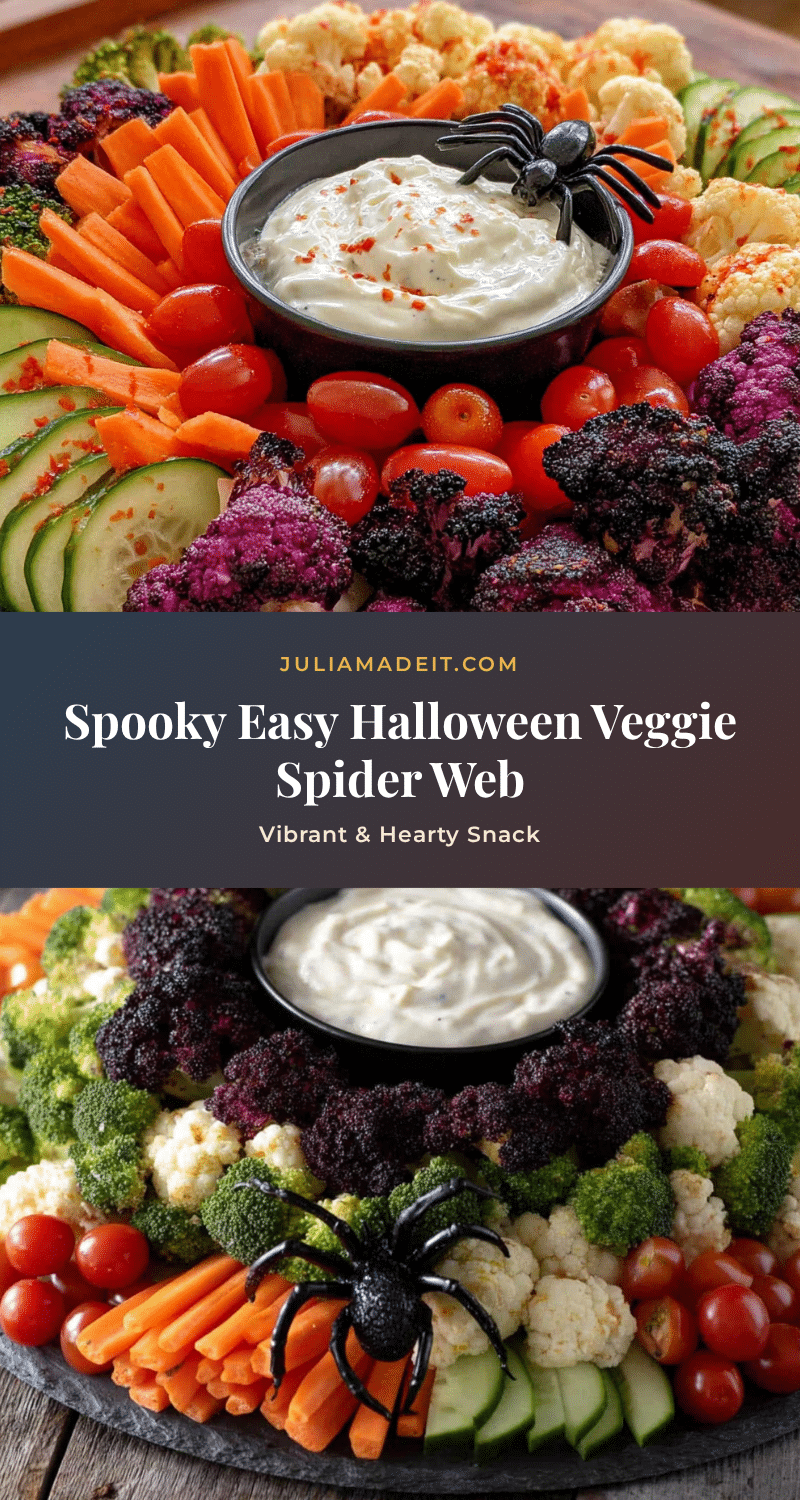
Spooky Easy Halloween Veggie Spider Web Tray: Best Party Appetizer
A spooky and easy Halloween veggie tray featuring a black sesame spider web drizzled over hummus, surrounded by colorful fresh vegetables. Perfect for parties, it comes together in under 15 minutes and is naturally vegan and gluten-free.
- Prep Time: 15 minutes
- Cook Time: 0 minutes
- Total Time: 15 minutes
- Yield: 8-10 servings 1x
- Category: Appetizer
- Cuisine: American
Ingredients
- 1 large round platter or cutting board (at least 12 inches in diameter)
- 1 cup hummus (plain or roasted red pepper)
- 1 large red bell pepper, sliced into thin strips
- 1 large yellow bell pepper, sliced into thin strips
- 2 cups baby carrots
- 1 cup cherry tomatoes, halved
- 1 cup cucumber slices, cut into rounds or half-moons
- 1 cup celery sticks, cut into 3-inch pieces
- 1 cup snap peas or sugar snap peas (optional)
- 1 small head of broccoli, cut into florets
- 1 small head of cauliflower, cut into florets
- Optional: black olives, sliced (for making spider shapes)
- 3 tablespoons black sesame paste
- 1 tablespoon olive oil
- 1 teaspoon maple syrup or honey (optional)
- 1–2 teaspoons water (as needed)
Instructions
- Prep your vegetables: Wash and dry all veggies thoroughly. Slice bell peppers into thin strips, cucumbers into rounds or half-moons, celery into 3-inch pieces. Break broccoli and cauliflower into bite-sized florets. Halve cherry tomatoes. Arrange in small piles near your work station.
- Spread the hummus: Spoon hummus into the center of a large round platter. Use a butter knife or offset spatula to spread it into a circle about 6-8 inches in diameter, about 1/4-inch thick.
- Mix the black sesame drizzle: In a small bowl, combine black sesame paste, olive oil, and maple syrup or honey (if using). Whisk until smooth. Add water 1 teaspoon at a time until it reaches a consistency similar to warm honey.
- Fill the squeeze bottle: Carefully pour the black sesame mixture into a squeeze bottle with a fine tip. Test the flow on a paper towel—it should produce a thin, steady line.
- Draw the web: Starting from the center of the hummus circle, squeeze a spiral of black sesame paste outward, covering the entire hummus circle with lines about an inch apart.
- Drag the web lines: Place a toothpick or skewer in the center of the spiral. Gently drag it outward toward the edge of the hummus circle in a straight line. Repeat every inch or so around the entire circle to create 8-12 spokes.
- Arrange the veggies: Place vegetable pieces around the outer edge of the platter, tucking them under the edges of the hummus circle. Arrange in groups by color, leaving space for the web to show through.
- Add the spiders (optional): Slice black olives in half lengthwise for bodies. Cut thin strips from another olive for legs—four on each side. Place a few olive spiders crawling across the web or climbing up broccoli.
- Serve immediately or refrigerate: Best served within an hour of assembly. If making ahead, prep veggies and drizzle separately; assemble just before serving.
Notes
For best results, let hummus come to room temperature before spreading. Keep veggies dry to prevent the hummus from sliding. Practice the spiral and drag technique on a plate first. The black sesame drizzle can be made ahead and stored in the fridge; let it come to room temperature before using. If you don’t have a squeeze bottle, use a zip-top bag with a tiny corner snipped off.
Nutrition
- Serving Size: 1 serving (approx. 1
- Calories: 120150
- Sugar: 57
- Sodium: 200300
- Fat: 79
- Saturated Fat: 12
- Carbohydrates: 1215
- Fiber: 45
- Protein: 45
Keywords: Halloween appetizer, veggie tray, spider web, black sesame, party snack, easy appetizer, vegan, gluten-free